x² GCSE Maths
GCSE & IGCSE tutoring that turns effort into results.
Targeted 1-on-1 support for every grade ambition, from securing a strong pass to reaching for 8s and 9s. We close the gaps, master the high-mark topics and build the exam technique that earns every available mark.

Year groups
Years 10–11
Ages
14–16
Tiers
Foundation & Higher
Exam boards
AQA · Edexcel · CIE
Format
1-on-1, live online
What we cover
The whole GCSE course, one topic at a time
Sessions follow your specification and your school’s order of teaching, or step back to secure earlier topics first, whichever helps most.
Number
- Fractions, decimals & percentages
- Indices, surds & standard form
- Bounds & estimation
Algebra
- Quadratics: factorising, the formula, completing the square
- Simultaneous equations & inequalities
- Functions, graphs & algebraic proof
Ratio & proportion
- Direct & inverse proportion
- Compound interest, growth & decay
- Rates of change & compound measures
Geometry & measures
- Circle theorems
- Trigonometry, including sine & cosine rules
- Vectors, similarity & congruence
Probability
- Tree & Venn diagrams
- Conditional probability
- Expected outcomes
Statistics
- Sampling & averages
- Cumulative frequency & box plots
- Histograms & scatter graphs
Specialist focus
The topics that make or break GCSE grades
These topics come up again and again, and they’re exactly where students tend to lose confidence. They’re also the areas I specialise in untangling.
GCSE · A-Level
Quadratic Equations
From factorising to the quadratic formula and completing the square, and knowing which method to reach for. We connect the algebra to the graph, so roots, turning points and the discriminant all make sense together.
- Factorising, including when a ≠ 1
- Completing the square & turning points
- The quadratic formula & the discriminant
- Quadratic inequalities & sketching graphs
- Disguised quadratics at A-Level
Δ = b² − 4ac = 16, so there are two distinct real roots: x = −1 and x = 3. Turning point (1, −4), a minimum.
GCSE · A-Level
Simultaneous Equations
Solving two equations at once by elimination, substitution and graphically. We then extend to one linear and one quadratic equation, a favourite for high-mark GCSE and A-Level questions.
- Elimination & substitution methods
- Graphical solutions & points of intersection
- Linear–quadratic pairs
- Forming equations from worded problems
KS3 · GCSE · A-Level
Algebra
Algebra is the language the rest of maths is written in. We make it fluent: expanding, factorising, rearranging and reasoning, so that nothing later on feels like a foreign language.
- Expanding & factorising expressions
- Solving linear equations & inequalities
- Rearranging formulae
- Algebraic fractions & proof
- Functions, including composite & inverse
Solve 3(x − 2) + 5 = 2x + 7
- 3x − 6 + 5 = 2x + 7expand the bracket
- 3x − 1 = 2x + 7tidy up
- x − 1 = 7subtract 2x
- x = 8check: 23 = 23 ✓
GCSE · A-Level
Circle Theorems
Circle theorems reward students who can see the structure in a diagram. I teach each theorem visually, then we practise spotting which ones apply and writing the reasons examiners want to see.
- Every GCSE circle theorem, with proofs
- Spotting theorems in complex diagrams
- Writing geometric reasons for full marks
- Equations of circles at A-Level
GCSE · A-Level
Exam Technique
Knowing the maths is only half the battle. We practise reading questions carefully, setting out working for method marks, managing time and checking answers, using real past papers from your exam board.
- Command words & what examiners expect
- Setting out working to earn method marks
- A timing strategy for each paper
- Targeted past papers & mark-scheme review
- Calculator skills & checking strategies
By completing the square, find the coordinates of the turning point of y = x² − 4x + 1. [3 marks]
y = (x − 2)² − 3M1
Turning point (2, −3)A1 A1
- Underline the command word
- Show each step for method marks
- Budget about a minute per mark
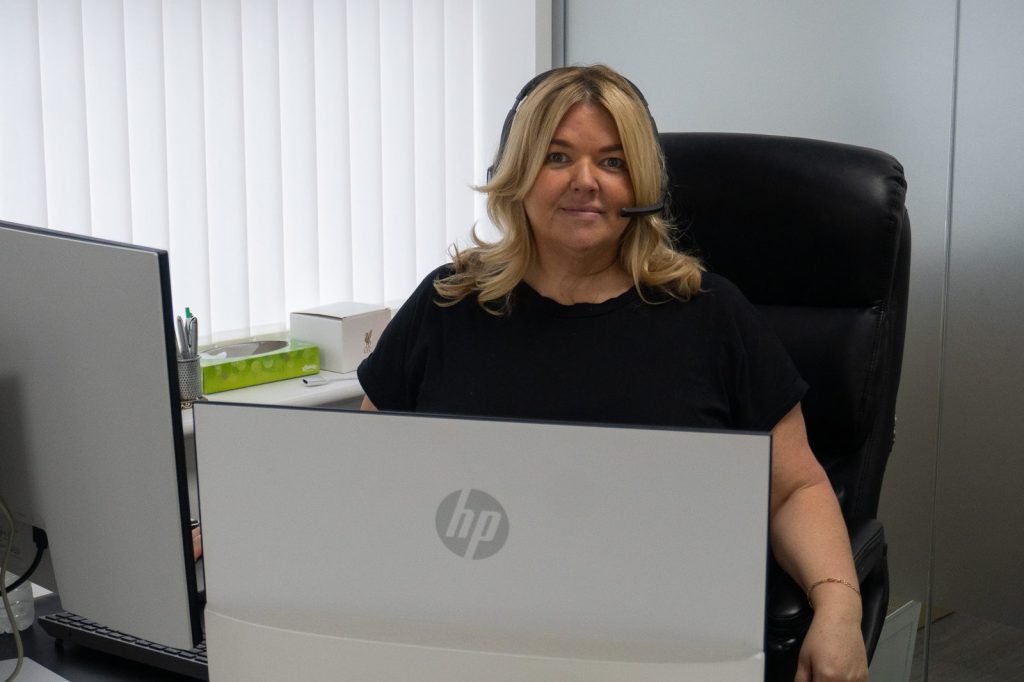
Inside a session
Live, focused and entirely yours
Every lesson happens live online, with a shared whiteboard so we can work through problems together, step by step. There’s time to ask every question, revisit anything unclear and practise until it clicks.
- Taught by a BSc Mathematics graduate
- Always 1-on-1
- A holistic approach that builds confidence
- UK & international time zones
- Matched to your exam board
- Sibling packages available
Foundation or Higher: which is right?
Your school decides the entry tier, but tutoring helps either way. We look at current work and target grades together, then focus on the topics that make the biggest difference, whether that’s securing a grade 5 or pushing for a 9.
Which exam boards do you cover?
All the major UK boards, including AQA, Edexcel (Pearson) and OCR. Sessions follow your specification and use your board’s own past papers.
When should GCSE tutoring start?
Year 10 is ideal for steady progress, but it’s never too late. Even a few months before the exams, focused sessions on the right topics can make a real difference.

Ready when you are.
Book a relaxed introductory chat, or send a message with any questions.